Why Taking Notes from YouTube Videos Is Killing Your Study Sessions
Taking notes from YouTube videos feels productive, but often wrecks focus. Try this paper-only chunk-and-recall workflow instead.
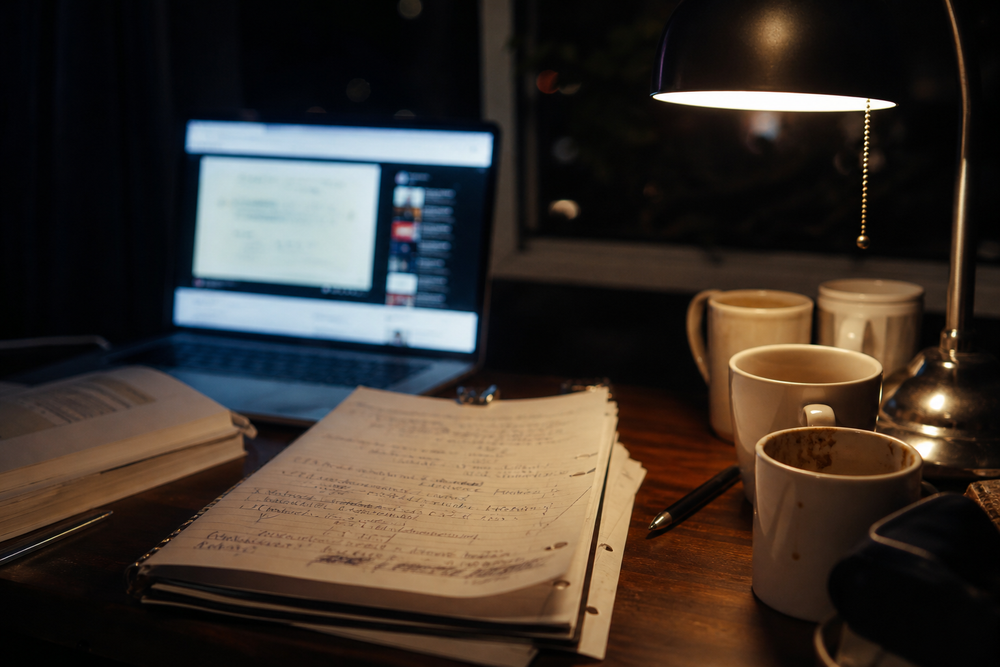
You open a 42 minute YouTube lecture, notebook ready, convinced you're about to be disciplined. Ten minutes later you've written six lines, paused the video fourteen times, and missed the explanation that actually mattered because you were still copying the previous sentence. That is not a focus problem. It's a bad study format.
Taking notes while a video is talking forces you to do three jobs at once: listen, decide what's important, and write fast enough to keep up. In a live lecture you sometimes have no choice. On YouTube, you do. Treating a replayable video like a live class is what turns a 45 minute lesson into a two hour slog.
The usual defense is that note-taking keeps you engaged. Sometimes it does. More often it gives you the feeling of engagement while your brain is stuck in clerical work. You leave with pages of fragments, arrows, half-finished definitions, and that weird false confidence that comes from seeing your own handwriting. Then two days later you read the page and realize you captured the noise and lost the structure.
The problem is not notes themselves. The problem is when you take them. If you're writing while the explanation is still unfolding, you're preserving words before you've decided what those words mean. That order is backwards.
Why video notes fail faster than textbook notes
A textbook sits still. A paragraph waits for you. You can reread the sentence, scan the heading above it, compare it to the diagram on the next page, and then decide what deserves a line in your notes. Video does not wait unless you force it to, and every pause breaks the explanation into scraps.
That matters because understanding from video is cumulative. A professor introduces a concept, gives an example, corrects a common mistake, then finally states the principle cleanly. If you start writing too early, you often note the setup instead of the conclusion. You capture the first version of the idea, not the refined one.
There is also a speed mismatch. Most people can handwrite usable notes at maybe 20 to 30 words per minute, less if they're trying to think at the same time. Explanatory speech often lands around 130 words per minute. Even at 1x speed, the lecturer is outrunning your pen by a ridiculous margin. Your only options are to write bad notes, pause constantly, or stop understanding the talk while you scribble.
That is why students end up rewatching. The first pass becomes a messy transcription attempt. The second pass is where they try to understand what they should have understood the first time. By then the study session feels long and serious, but a lot of the time went into manufacturing the need for a second viewing.
If this sounds familiar, compare it with the workflow in How to Study from YouTube Lectures as a Student. The useful shift is not "take better notes." It is "stop making note-taking your first job."
What to do instead on the first pass
On the first pass, your only goal should be to extract structure. What is this video mainly trying to teach? What are the three to five big moves? Where does the lecturer switch from background into the part you actually need? If you do not know the structure yet, detailed notes are premature.
This is the same reason I like building a skeleton before memorizing details. The post on why a mind map should be the first thing you build when studying something new makes the point well: your brain holds details better when it already knows where they belong. Video notes usually reverse that order. Students write down details first and hope structure appears later. Usually it doesn't.
So here is the better first pass: watch in uninterrupted chunks, pause only at planned moments, and write summaries from memory after the chunk ends. That one change fixes the biggest problem. You stop copying and start recalling.
When you write after a chunk instead of during it, weak understanding shows up immediately. If you cannot explain the segment in three or four lines from memory, you did not learn it. Good. Better to discover that at minute 12 than the night before the exam.
A manual workflow you can run tonight with paper and a pause button
You do not need any app for this. You need one video, one sheet of paper, and a timer. Use this for any YouTube lecture between 15 and 60 minutes.
- Set up the page in two columns, 2 minutes. Left column is for chunk summaries. Right column is for questions or gaps. Leave the bottom quarter of the page blank for a final synthesis.
- Watch the first 6 minutes without writing, 6 minutes. No pausing unless you truly lost the thread. Your job is to follow the explanation, not to capture it live.
- Pause and write a summary from memory, 2 minutes. Write three to five bullet points max. Not sentences copied from the lecturer. Your own wording only.
- Mark one confusion in the right column, 30 seconds. If something felt fuzzy, write the question, not a vague complaint. For example: "Why does velocity increase if pressure drops?" is useful. "Bernoulli confusing" is useless.
- Repeat the cycle for the next chunk, 6 to 8 minutes at a time. For dense material, use shorter chunks. For lighter review material, use longer ones.
- At the end, fill the bottom section from memory, 4 minutes. Write the whole lesson in five to seven lines as if a classmate missed the video and asked what mattered.
- Only then rewatch targeted moments, 10 to 15 minutes. Go back to the exact gaps you marked in the right column. Do not rewatch the whole thing because one part was shaky.
Total time for a 36 minute lesson is usually about 50 to 55 minutes. That sounds slower than just watching once, until you remember that the old method quietly included a second full viewing and notes you barely trusted. This method builds review material and diagnosis in the same session.
A worked example: a 32 minute calculus video on integration by parts
Let's make this concrete. Say you're studying integration by parts from a 32 minute YouTube lesson before a quiz. Under the old method, you'd pause every 20 seconds to catch formulas, fill a page with symbols, and still have no idea when to choose integration by parts over substitution.
With the chunk method, I would split the video like this.
Chunk 1, 0:00 to 6:00. The lecturer explains the intuition: integration by parts is useful when the integrand is a product and one part becomes simpler when differentiated. After six minutes, your summary might be: "Use when I have two multiplied pieces. Differentiate the part that gets simpler. Integrate the part that stays manageable. Goal is to trade a hard integral for an easier one." Your right-column question might be: "What counts as simpler in practice?"
Chunk 2, 6:00 to 13:00. The lecturer derives the formula from the product rule. Your summary: "Product rule reversed gives integral of u dv equals uv minus integral of v du. Formula is not random, it comes from differentiation." That is already better than a copied line of notation because it includes meaning.
Chunk 3, 13:00 to 21:00. First worked example, something like x ex. Your summary: "Choose u = x because derivative becomes 1. Choose dv = ex dx because antiderivative stays ex. Result collapses fast." Right-column question: "Would choosing u = ex ever make sense?"
Chunk 4, 21:00 to 28:00. Second example, maybe x ln x. Now the method gets interesting because dv is not always the obvious part. Your summary: "When a logarithm is present, make log the differentiated part because derivative simplifies to 1/x. That usually cleans things up."
Chunk 5, 28:00 to 32:00. Recap and common mistakes. Your summary: "Main failure points are picking u badly, dropping the minus sign, and using the method when substitution is easier."
Now write the bottom synthesis from memory: "Integration by parts is for products where one factor gets simpler when differentiated. I should recognize it especially with x times an exponential, trig function, or logarithm. I am not memorizing a random formula. I am reversing the product rule to turn one ugly integral into a cleaner one."
That final paragraph is study gold because it tells you what you actually know. If you cannot produce it, you are not ready to move on. If you can, your later review becomes fast. One page. Five chunks. Three real questions. No transcript cosplay.
Why this works better than traditional notes
This workflow forces retrieval, triage, and selective review. Retrieval matters because memory strengthens when you pull ideas out of your head, not when you watch them go by again. Triage matters because not every minute of a YouTube lesson deserves equal attention. Selective review matters because the fix for confusion is usually 90 seconds of rewatching, not another 32 minute lap.
It also gives you cleaner notes. Your page now reflects the architecture of the lesson, not the order in which the lecturer happened to speak. That difference seems small until revision week, when structured notes are usable and transcript-style notes are a pile of witnessed events.
There is one tradeoff: this method can feel less productive at first because your pen is idle during the chunk itself. Good. That idle pen is buying your attention back. If you are the kind of student who panics when not writing constantly, that discomfort is probably evidence that the old habit was performative, not efficient.
Use live note-taking only for material that is already familiar, where your brain can predict where the explanation is going. For new or difficult material, chunk first, summarize second, then patch the gaps. That sequence is much harder to fool yourself with.
Tonight, pick one YouTube lesson you've been avoiding, set a 6 minute timer, and ban yourself from writing until it rings. Then summarize the chunk from memory on paper. If your summary is thin, good. Now you know exactly where the studying starts.